

Recent Recordings by Area Artists
The jazz faculty of Michigan State University in East Lancing has been on a CD release roll lately, bringing much praise and attracting attention to its stellar academic jazz program. The latest in this series is by trumpeter and composer Anthony Stanco: a new album, In the Groove: Live at the Alluvion, with guitarist Randy Napoleon, pianist Xavier Davis, bassist John Webber, and drummer Joe Farnsworth, recorded almost exactly a year ago. This recording documents a show at the wonderful new Alluvium performance space in downtown Traverse City that features many kinds of music, including jazz, curated by pianist Jeff Hass, who contributed the liner notes to the album and wrote one of the tunes (“Tales”). Of the other eight tracks, only one is an older classic — Duke Pearson’s “Say You’re Mine,” first heard on the 1962 Donald Byrd Blue Note album The Cat Walk — “Hey Cute One,” contributed by Napoleon, and the remaining seven were composed by the leader.
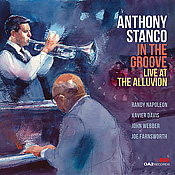
Raised in the Detroit suburbs, Stanco was tutored early in his life by musicians such as Marcus Belgrave and Rodney Whittaker in the Civic Jazz Orchestra, absorbing the unique Motor City jazz ethos, moving on to the Manhattan School of Music, but finishing up his college education back in Michigan, at Michigan State in the jazz program directed by Whittaker. Eight years later, after teaching at Ohio State and Broward College, he returned to the school as assistant professor of jazz trumpet. On this album, just as on his previous four, Stanco celebrates his dedication to the bebop/hard-bop legacy, with his own take on the Detroit traditions instilled in him while still a teenager mentored by notable elders, with its characteristic accent on precise technical instrumental mastery as a vehicle for passionate expression, often with the blues in mind. A good example of all of this is found right away on the second track, the aforementioned “Say You’re Mine.” The arrangement of the head essentially follows the Donald Byrd version, but whereas his predecessor, not that much older at the time, used a mute, stressing the somewhat melancholy spirit of the minor key blues-like tune, Stanco plays with open horn, tipping his hat to his Detroit precursor, but more assertive and declarative. He cues in Napoleon, who takes his time to build an atmospheric bluesy solo, handing it over to Stanco, who stays very much in the same vein, accentuating the blues, bending and smearing notes, making a compact forceful statement. When Stanco picks up a mute, as on the boogaloo title tune, he goes all out, laying on the funk. Throughout, one hears the close musical bonds between the band members, who clearly share aesthetic and stylistic attitudes, reinforced by personal relationships.
This is very much a performance recording, structured with audience entertainment in mind, sometimes bringing to mind Art Blakey’s Jazz Messengers. The tempos, rhythms, and timbral arrangements vary-- there is even a short band vocal on “Sonny Boy.” Stanco is a declared traditionalist who does not hide his allegiance to Byrd, Lee Morgan, or Clifford Brown, but he has forged his own take on the hard-bop style, and his impressive command of the trumpet serves him well but is never used for simple effect. All in all, this was obviously a wonderful evening at the Alluvion, shared with us by the full and clear recording to savor at will.
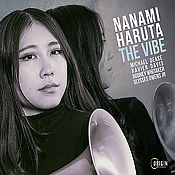
The faculty of the Michigan State School of Music are not just teachers. They are mentors as their commitment to students clearly reaches far beyond the classroom and they often involve them in their professional performances. To cite but one example, for his recent album Waking Dream guitar professor Randy Napoleon brought back four of his former students. Trombonist Nanami Haruta has just released her debut recording, and her teachers were not only featured sidemen, but also contributed their own compositions to the project, and her mentor Michael Dease coproduced it. The CD is Nanami Haruta, The Vibe, with Michael Dease on trombone and baritone saxophone on five tracks, Xavier Davis on piano, Rodney Whitaker on bass, Ulysses Owens Jr. on drums, and on one tune, recent alumnus Chris Minami on guitar. Dease joins Haruta on five tracks, another five feature her in a quartet setting, and the final one finds her in the intimate company of just guitar and bass.
Played on a blindfold test, one would never even begin to think that this was a debut album by a recent college graduate. Haruta has full technical command of her instrument, with remarkable tonal control and jazz phrasing, her solos demonstrate melodic and harmonic mastery of post-bop jazz traditions, reflecting the style of music making preferred by her Michigan State mentors. Her approach to the trombone lies fully in the J. J. Johnson lineage but she has already managed to find her own stylistic persona within this methodology, with a recognizable warm tonal palate. The album is organized in a manner that features the full range of her talents. Her musical maturity is well on display on the first few tunes where she works alongside her teacher Dease, matching him fully with delight. Once we get to the second half of the recital where she works alone with the rhythm section, the accent is more on her wistful and romantic side, as the tempos slow down, and she tells her stories with passionate imagination. By the time we reach the final tune, “Unchained Melody,” the one standard here, she revels in her ballad artistry, accompanied only by Minami and Whittaker. A perfect final moment in a remarkable album of mainstream modern jazz.
Late this fall, Ellen Rowe, a University of Michigan music professor with a heavy performance schedule at home and throughout the country, released her sixth compact disc recording that features her piano, compositions, and arrangements in a new quartet; Vinton’s Cove features Mike Sakash, alto and soprano saxophones, Dennis Carroll, bass, Pete Siers, drums, and vocalist Sunny Wilkinson on two tunes.
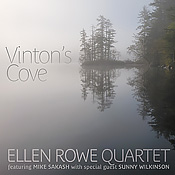
Of the ten tracks, six were written by the leader, two are old standards, plus one each by Kenny Warner and Joni Mitchell. The CD title references Rowe’s family cabin in Maine, where she has spent summers since childhood, and so it opens with her composition “The Loons of Vinton’s Cove,” referencing a pair of birds that return there every spring and attempt, against all odds of nature, to bring a chick or two to maturity. At a brisk, rolling tempo, this provides a perfect introduction to the unique quartet of musicians. The only one who has worked regularly with Rowe before is her longtime favorite drummer Pete Siers. Bassist Dennis Carroll, well-known in Chicago, is a recent acquaintance, as is saxophonist/clarinetist Mike Sakash, a neighbor in Maine, where he has been working for some years at the Fryeburg Academy, currently chairing the arts department. His approach to the alto saxophone catches you by surprise, very much against the current grain, with a warm sweet sound that derives from the Paul Desmond lineage, and a sparse, precise way with melody that fits perfectly with Rowe’s compositional and arranging concepts. The quartet swings together so well that one would never suspect that it is not a regularly working band.
By contrast, Rowe’s characteristically contemplative ballad “Refractions” features Sakash’s full-sounding soprano saxophone. Here, the musical kinship between the two comes into full focus, as they build their solos together, with effective dynamic shading. The recital is meticulously designed, with diverse tempos, moods, and orchestrations. The delicate “Sylvan Way” is a perfectly intuitive duet with Sunny Wilkinson, who shines in a very different mode on the brisk samba “The Phoenix.” Mitchell’s “Both Sides Now,” hardly a jazz standard, reveals new improvisatory prospects in an introspective trio setting.
Ellen Rowe prepares each of her recordings with great care so that they all differ substantially and reveal new perspectives on her art. On Vinton’s Cove she has once again succeeded in evenly balancing her compositional, arranging, improvisatory, and leadership skills to create a highly personal musical statement, programming the whole so that each track acquires full meaning as part of a whole. Her compositions are often organically realized only in specific arrangements in which her piano is an essential orchestral element but are also created or recreated to accommodate the personalities of her fellow musicians, in this case, for example, exploiting the unique stylistic qualities of Mike Sakash’s approach to his instruments, which differs substantially from the styles of her usual saxophone companions. Therefore, to fully experience the artistry at play here, put this on and listen from beginning to end.