
|
|
Ursula Walker to Receive SEMJA Award October 29 BY LARS BJÖRN
This
year's SEMJA Award will be given to singer Ursula Walker
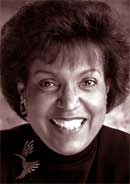
on Sunday, October 29, at the Bird of Paradise The SEMJA Award is given annually to someone who has contributed significantly to the jazz community of Southeastern Michigan. Previous recipients have been the late pianist Judge Myron Wahls and saxophonist/educator Ernie Rodgers. Ursula Walker has been a major presence on the Detroit jazz scene as a vocalist and an educator for over forty years. Walker is generally considered Detroit's premier jazz vocalist — she has turned down offers to leave town from the likes of Basie and Kenton. She got started early. At eleven she was singing on WXYZ-TV. In her teens was part of the Jimmy Launce Music Hall Cavalcade on radio station WJR, and she did a lot of work as a singer of jingles. From the start she also sang in more clearly jazz oriented settings. She was only eleven when she did dance studio work with the Jimmy Wilkins Orchestra at the Latin Quarter. Around 1960 she got a call from vibraphonist Jack Brokensha, who had heard her on TV and wanted her for a concert. She later worked with him and Bess Bonnier at Brokensha's club in the New Center area. Walker worked with two prominent piano trios in the 1960s: Terry Pollard's at private parties and Matt Michaels' at places like the Playboy Club. She also learned a lot from working with pianist Howard Lucas. Since 1971 her major pianist has been Buddy Budson, whom she married in 1974. She was the main vocalist for the Brookside Jazz Ensemble in the seventies and eighties, including several years at the Top of the Pontch. Recently Budson and Walker have performed in the Jazz Stage series at Orchestra Hall and at the Firefly in Ann Arbor. Jazz education has been a strong interest of Walker's for some time. She worked at the Center for Creative Studies for a couple of years and put on clinics at schools, colleges, and the Actors' Alliance Theatre Company. In a phone conversation with Lars Bjorn she mentioned that she is looking forward to a clinic at the Michigan Opera Theater later this summer. This clinic will be directed at young students of classical music who want to know more about improvisation. She also said that she thinks she can help the next generation of singers, like those she mentors in the Sisters of Jazz program, with phrasing. More specifically, she wants to show "how to phrase a lyric and make sense and not cut off your syllables." I N - T H I S - I S S U E : |
|||
|
||||






 in
Ann Arbor. Please set aside the hours of 5:00 to 8:00 p.m. to come to
the Bird to celebrate Ursula with music, food and drink. A $25 door charge
will include music by Ursula's quartet and food. Walker's quartet includes
Buddy Budson on piano, Dan Kolton on bass and Tom Brown on drums. This
event is a fund-raiser, so any surplus from the evening will benefit SEMJA's
jazz education efforts. The Bird of Paradise is now located at 312 South
Main Street in Ann Arbor. Please call 734-662-8514 for more information.
in
Ann Arbor. Please set aside the hours of 5:00 to 8:00 p.m. to come to
the Bird to celebrate Ursula with music, food and drink. A $25 door charge
will include music by Ursula's quartet and food. Walker's quartet includes
Buddy Budson on piano, Dan Kolton on bass and Tom Brown on drums. This
event is a fund-raiser, so any surplus from the evening will benefit SEMJA's
jazz education efforts. The Bird of Paradise is now located at 312 South
Main Street in Ann Arbor. Please call 734-662-8514 for more information.