

Lars Bjorn Receives SEMJA’s Ron Brooks Award
Every year, the Southeast Michigan Jazz Association (SEMJA) board presents the Ron Brooks Award to individuals who have made significant contributions to the Detroit jazz community as performers and/or educators. This year, the award, named after the organization’s founder, goes to Lars Bjorn, who has led SEMJA as president for the last two d ozen years. The presentation will take place at the Kerrytown Concert House, which has partnered with our organization to celebrate Lars, at 4:00 p.m. on March 1, 2026. A short ceremony will be accompanied by of a full concert by bassist Paul Keller, pianist Adam Mosley, guitarist Ralph Tope, drummer Jesse Kramer, and a few surprise guests.
Lars was born and raised in the Swedish port city of Gävle. His passion for jazz began early, when he heard the wonderful American trumpet player Benny Bailey who had settled in Sweden while touring there with Lionel Hampton’s big band. Soon he was attending concerts by touring grou ps and even playing drums in an amateur group called Trio A Go Go. Scandinavia was a hotbed of jazz at the time, with its own vibrant scene, but also with many US expatriates living there, including Stan Getz, Ben Webster, Dexter Gordon, Kenny Drew, and Art Taylor and was an important destination for touring musicians such as Duke Ellington, Count Basie, Thelonious Monk, the Chicago Blues All-Stars, and even Sun Ra, all of whom Lars could hear in his home town, during visits to Stockholm, and then once he moved to attend university, in the capital and in Uppsala. Looking back, he observed, “those were wonderful days as I was fortunate to hear all these fabulous musicians as a youngster in my hometown!” Upon graduation, he left for the United States with a fellowship to attend graduate school at the University of North Carolina, where in 1974 he earned his PhD in sociology. He was then appointed as a professor of sociology at the University of Michigan-Dearborn campus, where he worked until his retirement in 2013.
 Lars settled in Ann Arbor but much of his research and teaching began to concentrate on the city of Detroit, focusing on labor, class, and race, much of it in association with the auto industry, but also quickly became immersed in its rich musical community. He began to interview and write articles about Motor City musicians and their culture but also became actively involved with the scene, joining the board of the Detroit Jazz Center led by John Sinclair, Herb Boyd and Kenn Cox and later becoming a supporter of the Societie of the Culturally Concerned founded by Barbara and Kenny Cox.
While teaching courses about Detroit and its jazz he quickly realized how little research had been conducted on the subject. Together with Detroiter jazz chronicler and DJ Jim Gallert he initiated a longer-term project to investigate and document the often-overlooked rich history of African American music in the city. Th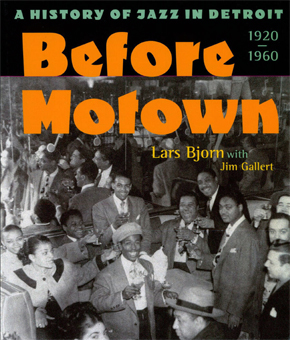 is involved much archival work, searching out unpublished memoirs and documents, but also seeking out musicians, presenters, and even fans who still remembered days gone by and then recording and transcribing extensive interviews with them. Eventually, all this data was synthesized by Lars and Jim in a pioneering book, Before Motown: A History of Jazz in Detroit, 1920–60, published by the University of Michigan Press in 2001. Written with a broader public in mind but academically sound, the work combined portraits of musicians set against the social history of the city and the times, delving into race relations and urban history, including the effects of the destruction of Paradise Valley and Black Bottom, the economics and community settings of the entertainment business, mapping venues, various associated civic organizations, and the importance of communal values. Since then, many others have taken up the topics, often inspired by this unique book, but it retains its importance to this day. Even so, only a small portion of the researched material could be used in the book, but their archives, now deposited at Eastern Michigan University, will provide an unparalleled rich source of data for chroniclers and scholars of Detroit music history for generations to come, as will the interview tapes, which will also be deposited for others to use. Lars and Jim often lectured on the subject of the book and for years they operated the Jazz Talk Tent at the annual Labor Day weekend Detroit Jazz Festival, running interviews and panels with some of the world’s top jazz artists, scholars, and journalists. In 2018, the Jazz Journalists Association honored them as Jazz Heroes for the book and for their individual and collective work on behalf of the Detroit jazz community.
 In addition to his more formal labors, the love of jazz has permeated Lars’s life. He met his future wife Susan Wineberg in August of 1976 at a table at one of the regular free Sunday afternoon jazz sets at the marvelously funky Del Rio bar that operated between 1969 and 2004 at the northeast corner of Ashley and Washington Streets in Ann Arbor, in the space now incorporated into the Grizzly Peak restaurant. The music, often including one of the owners, Rick Burgess, at the piano, featured many of the area’s finest jazz musicians, with some, like multi-instrumentalist Sherman Mitchell, coming from as far away as Flint. When Lars and Susan eventually decided to get married in August 1984, the days-long celebrations, with family and friends from Sweden and elsewhere culminated with a party and reception at the Cobblestone Farm and the wedding band consisted of the Ron Brooks trio with pianist Rick Roe and drummer Pete Sears—the house band of the Bird of Paradise jazz club—with the addition of saxophonist/flutist Paul Vornhagen.
SEMJA was born in the spring of 1987, created at the Bird of Paradise jazz club — led by Ron Brooks — by the bassist together with Don Chisholm and Michael G. Nastos. Soon they were joined by several other individuals, including Lars Bjorn, who became the editor of its monthly Update publication and eventually in 2004 the organization’s president, a position he continues to hold today. Over the years he has officiated over the presentation of the Ron Brooks Award, established in 2012 to commemorate the quarter century of SEMJA’s existence and to honor its founder. This year he will temporarily step back to be the recipient of the recognition he so richly deserves.