


Recent Recordings by Area Jazz Artists
One often hears the aphorism that Detroit is a bebop town. Certainly, the mainstream of jazz creativity in the area has been focused on varieties derived from the legacy of Barry Harris, the Bluebird Inn house band, the teachings of Wendell Harrison, Marcus Belgrave, and many others, but there have always been more experimental movements explored by the city’s artists, including some of the musicians just referenced. The sixties and seventies of the last century, filled with social drama all over the planet, including local tragedies such as the Detroit riots, upended much of the status quo, giving rise to new social and political relations and political awareness, and this frequently found expression in artistic innovation. African American musicians asserted their liberation from systemic exploitation by organizing; Chicago gave birth to the Association for the Advancement of Creative Musicians (AACM), St. Louis to the Black Artists Group (BAG), and in Detroit pianist Kenny Cox founded Strata Inc. and Wendell Harrison with Phil Ranelin created Tribe, both embracing a broad range of jazz expressions. One of the great combos to come out of that era was Griot Galaxy. Saxophonist Faruk Z Bey had created several groups before he organized this one in 1972, moving from experiments with completely free improvisation to focus on compositions that investigated complex, often overlapping multiple rhythms, exploiting the sonic possibilities of multiple woodwinds, dramatically amplified linguistically by Bey’s poetry and visually by elements such as silver face paint, reflecting the strong influence of the AACM and Sun Ra. In its first phases various musicians came and went, and the size of the unit varied, but eventually it stabilized as a quintet with three woodwind players that lasted until 1985, when Bey was seriously injured in a motorcycle accident, leading to years of recovery. The group reconvened occasionally, but for all practical purposes its best days were gone, and its members moved on to other glories.
Unfortunately for us today, the recorded legacy of Griot Galaxy is meagre. A few tracks in compilations aside, the band only released two albums, Kins, and Opus Krampus. This documentation was doubled when, in 2003, Entropy Stereo put out a wonderful double CD Live at the D.I.A. from a 1983 concert (reviewed in the June/July 2003 issue of this UDATE). Now, the Two Rooms label in Detroit has produced another rediscovered set, Griot Galaxy: Live at WUOM 1979, offering almost an hour and a half of music in CD or double LP versions. The session was recorded in very good sound in the studios of Ann Arbor’s public radio WUOM-FM in the golden days when it was still a music station for a show presented by Michael Grofsorean (whose familiar voice can be heard introducing the final track) and carefully remastered by Warren DeFever. This was the quartet version that consisted of Faruq Z Bey and Anthony Holland, on this set both on alto, soprano and tenor saxophones as well as bass clarinets, with Jaribu Shahid on double bass, and Tani Tabbal playing drums and percussion. The poetic but informative liner notes by W. Kim Heron provide a very good capsule introduction to the Galaxy.
The six long tracks consist of familiar Griot compositions, three by Bey and one by Tabbal and two by Shahid, all but the leader’s “Osiris” available in other versions on other albums by the band; some, including the latter, were also revisited by Bey decades later when he was featured on many recordings by the Northwoods Improvisers.
While Bey may have been the leader, we are listening to four equal voices working telepathically with one another, creating a unified sound space like no other. The two woodwind players each brought three horns; interestingly, on almost all the tracks they each use the same ones, providing a chance to compare their individual approaches. Thus, on the initial “After Death” Bey and Holland are on soprano saxophones. Shahid sets the stage and then on the initial theme they dance around each other and the following solos, Bey followed by Holland, allow us to hear their somewhat different sounds, with the latter slightly sweeter toned, with a bit less of the blues, both complementary as they come together and apart, with the leader playing the main melody against Holland’s repeated riff. The next track, “Dragons,” is once again initiated by the bass, this time faster. The drums come in and then the two saxes begin plaintively together, switch to a riff and then to other short themes, some in unison, some not, with contrasting dissonant moments. “Osiris,” opens quite differently, with Bey unaccompanied on tenor, alternatively down home and sweet, tipping his hat to tradition, and is then joined by Holland on alto as they set up the quirky theme, eventually settling into a swinging one, a tenor solo, collective jamming, and then the alto settles down into a laid back solo that takes its time developing motifs. With further contrast, Shahid’s “Androgeny” starts all mystery, bowed bass, other sounds, over which Bey recites his own poem. A slow, wistful melody follows, followed by series of unexpected rhythmic, tempo, and timbral shifts, eventually coming back to the initial mystery.
This recital demonstrates the unique complexity of Griot Galaxy’s creativity founded in precise instrumental virtuosity, rhythmic curiosity, seamless listening, knowledge of various musical genres, an experimental ethos that was very much anchored by love of tradition, and a love of surprise. Faruk Z Bey is no longer with us, but the other Griot members, including saxophonist David McMurray who would join them soon after this radio event, are very much with us, creating magnificent works. In a couple of weeks prior to the release of this album I had the opportunity to hear Anthony Holland and Jaribu Shahid in different contexts in Detroit playing exquisitely as their art ever progresses upwards.
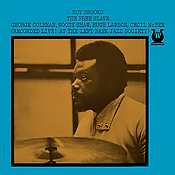
We now take a listen to another historical CD that documents a different aspect of the kaleidoscopic richness of Detroit music making. Muse Records was a jazz label created in 1972 that for over two decades documented a wealth of choice musical creation. Now, Time Traveler Recordings has undertaken to reissue some of these albums in a new Muse Master Edition Series on both LP and CD. Among its first presentations is The Free Slave, recorded in 1970 under the leadership of the great drummer Roy Brooks, with a first-class lineup of Woody Shaw, trumpet, George Coleman, tenor saxophone, Hugh Lawson, piano, and Cecil McBee, bass. The new remastering by Matt Luthans is outstanding.
Brooks grew up just up the street from the Blue Bird Inn, where the famed house band included one of his first drummer heroes, Elvin Jones. In 1959, on the recommendation of childhood friend Louis Hayes, at age 21 he went to New York to replace him in the Horace Silver Quintet, one of the top touring modern jazz groups of the time, staying with the group for almost five years. Silver’s music was a popular version of hard bop, refining the music by incorporating blues, funk, gospel, soul, and Caribbean elements in a highly melodic framework, performed by first rate musicians, anchored by the leader’s distinctive pianistic and compositional skills. This was the perfect finishing school for Brooks, whose varied early Motown experiences, from bebop to rhythm and blues, prepared him well for this kind of eclectic soulful music making. After leaving Silver the drummer remained in New York, and from 1966 on teamed up with his old hometown friend Yusef Lateef, playing in his quartet with Hugh Lawson and Cecil McBee, who he called upon to join him for the gig at Baltimore’s Famous Ballroom in 1970 that is documented on this recording.
The Free Slave contains four long tracks, three composed by the drummer and one by McBee. While he takes only two solos, Brooks clearly leads the group; his dominating power recalling the drive that Art Blakey used to propel his Jazz Messengers. This was not a studio session, rather it was a raucous live gig and the interaction with enthusiastic listeners very much contributes to the success of these tracks. Between 1966 and 1984 the Left Bank Society presented some of the very best in jazz every Sunday from 5 to 9 PM to an integrated audience, with kids welcome, in a place that was once a dance hall modeled on New York’s Roseland, a place where people could bring the whole family, together with their own food and drink or buy great soul food.
Perhaps more than any other recorded document, The Free Slave confirms that Brooks was a unique master of polyrhythmic drumming that never lost the propulsion of swing, equal to, but quite different from Elvin Jones or Tony Williams. There are no ballads here, just four middle/uptempo compositions that filled the house with power and momentum. The opening title tune begins with a two-bar bass riff that leads to a simple repeated soulful melody with a boogaloo beat. The riff continues behind the soloists (sax, trumpet and piano) who delve deeply into the blues. You can almost feel the tension as everyone is working to create a mood of implied power. At the end the horns lock together and then calm down. This leads to a more delicate feeling on “Understanding,” a tune that must have reminded many in the audience of “Song for My Father,” that the drummer had played countless times while with Silver. The soloists move into more adventurous territory here, heating things up considerably as they improvise together at the end something they will take even further on McBee’s “Will Pan’s Walk,” structurally the most complex one of the afternoon. Brooks drives everyone with panache and takes his first solo, as does the composer. The audience can be heard encouraging the band on as they prepare to play the last tune, the leader’s “Five for Max,” in 5/4 time, but a far cry from “Take Five,” one that once again has traces of Silver’s style. The leader solos here in a melodic vein, incorporating the breath-a-tone, a technique that allowed him to change the pitch of drums, blowing air by two tubes, something Brooks invented, based on an idea mentioned to him by Yusef Lateef.
This is a document of but one late afternoon half a century ago before a large enthusiastic, relaxed audience from a period when the music was going through fluid creative changes. Brooks had met Coleman, who had toured with Miles Davis and Horace Silver, while recording with Chet Baker; he had often played with Shaw, another Silver alumnus and perhaps the most harmonically advanced player on this session, and, as already noted, he had been working regularly with Lawson and McBee in Lateef’s quartet. As a result, it is hardly surprising that the band worked so well together and navigated the sometimes-quirky compositions with ease. Shaw is particularly impressive here, at at an artistic peak, but still working towards the unique style that would be so characteristic of his mature work, by which time he had shaken off the remnants of the Freddie Hubbard influence. It is fascinating to compare his playing here, as well as that of Brooks, with what they were doing sixteen years later when they recorded Beshma Swing under the trumpeter’s name with pianist Geri Allen and bassist Robert Hurst over two evenings at Baker’s Keyboard Lounge in Detroit. It was something to remember—I was there and only wish I could have been at the Famous Ballroom in 1970 as well!